
This question is harder than it seems.
Often people with depression or anxiety try things like exercise, mindfulness, yoga, or individual or group therapy — and when those don’t fully work, they start wondering whether they need an antidepressant.
Like with any other drug, you want to weigh the odds of successful treatment against the odds of side effects, both short-term and long-term. So how do you know if an antidepressant is likely to help you?
The statistic everyone quotes — and what it actually tells you
Large-scale research syntheses on antidepressants report modest average effects: across studies, antidepressants outperform placebo, but usually not by a huge margin. A useful way to picture this in absolute terms: if 40 out of 100 people improve on a placebo, maybe 50–60 out of 100 improve on an antidepressant.
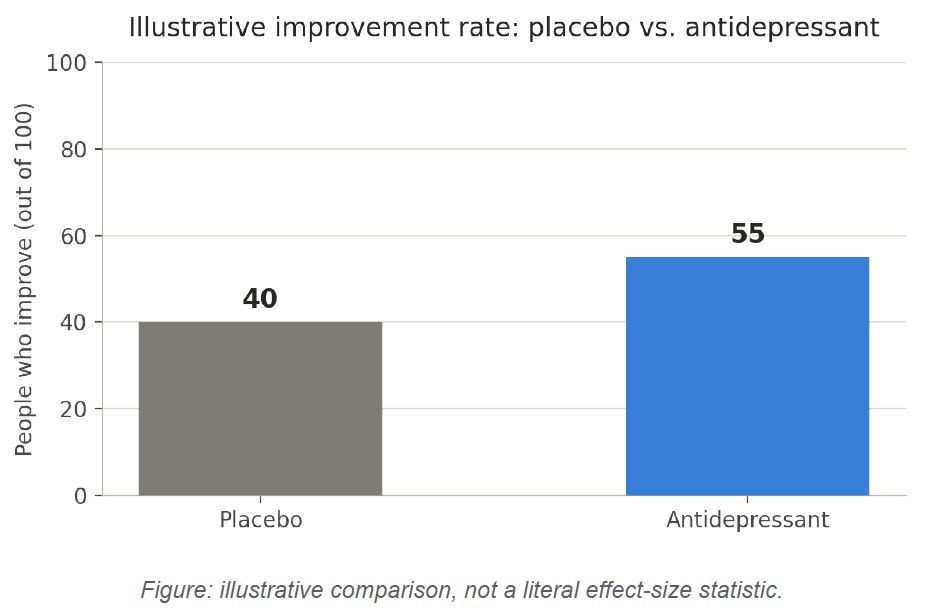
That’s a meaningful difference at the population level. But it answers the wrong question for an individual. Knowing that a drug helps 10-20 more people out of 100 doesn’t tell you whether you’re one of them. It’s a bit like knowing a basketball team has won 55% of its games this season — useful for betting on the season as a whole, but it tells you almost nothing about whether they’ll win tonight’s game.
A better question: which factors predict a good response?
To know whether tonight’s game is a good bet, you’d want more specific information — is the team playing at home? Is their star player healthy? The same logic applies here: instead of relying on the population-wide average, it helps to know which individual factors are associated with a better or worse response to antidepressants.
A research group building a machine-learning model to predict antidepressant response compiled a comprehensive list of such factors. Here’s a pared-down version:
- Factors associated with a higher response rate
- Certain symptoms, such as early-morning waking, loss of appetite and weight, slowed physical movement, or an inability to experience pleasure (anhedonia)
- Greater overall severity of symptoms
- Strong social support — a supportive family, friends, or living with a spouse
- Certain genetic variations affecting serotonin signaling
Factors associated with a lower response rate
- Age extremes (very young or very old)
- Alcohol or other substance use
- Significant problems with concentration or memory
- Prominent anxiety symptoms
- Other genetic variations affecting serotonin signaling
It’s worth discussing these factors with a prescriber before deciding whether to start an antidepressant — they won’t guarantee an outcome, but they shift the odds in a way that’s actually relevant to you, rather than to “people in general.”
Why “just try it and see” isn’t risk-free
Some people take a trial-and-error approach: try an antidepressant for a few weeks, and stop if it doesn’t work. This isn’t as low-risk as it sounds. Antidepressant withdrawal can, in some cases, become a severe and debilitating condition of its own. The possibility of a withdrawal syndrome needs to be weighed before starting one of these drugs — not treated as an easy exit if things don’t work out.
Bottom line
These are powerful drugs with effects that vary a lot from person to person. Rather than asking “do antidepressants work?”, the more useful question is “which of the factors that predict a good response apply to me?” — and that’s a conversation worth having directly with whoever is prescribing.